




NLM/AAHSL Leadership Fellows Program
The Association of Academic Health Sciences Libraries (AAHSL) is pleased to announce the 2009-2010 year of the leadership program jointly sponsored by the National Library of Medicine (NLM) and AAHSL. In response to the confirmed need for future leadership, the NLM/AAHSL Leadership Fellows Program is focused on preparing emerging leaders for the position of library director in academic health sciences libraries. Fellows will have the opportunity to develop their knowledge and skills in a variety of learning settings, including exposure to leadership in another environment. They will be paired with mentors who are academic health sciences library directors. In addition to the individual relationship with their mentors, fellows benefit from working collaboratively with other fellows and mentors. Experienced Program faculty and mentors will provide content and facilitation for the cohort. The Program takes advantage of flexible scheduling and an online learning community to minimize disruption to professional and personal schedules. The sponsors will provide financial support for up to five fellows and will underwrite travel and meeting expenses.
2009 AAHSL Cornerstone Award presented to Tony Mazzaschi
I want to announce the recipient of the 2009 AAHSL Cornerstone Award, given by the association for notable contributions that have assisted AAHSL in achieving its mission or have had significant impact on the profession of academic health sciences librarianship.
The AAHSL Board of Directors is pleased to present the AAHSL Cornerstone Award to Tony Mazzaschi, Senior Associate Vice President for Biomedical and Health Sciences Research at the Association of American Medical Colleges (AAMC). The following have been noted among Tony’s many contributions:
- As AAMC liaison for CAS, Tony ensures that AAHSL issues are brought to the attention of Council of Academic Societies (CAS) membership.
- Tony served as the driving force behind the development of the CAS Scholarship Dissemination Project, providing widespread understanding of the significant changes taking place in medical and biological sciences as scholarly communications move from print to digital. The work of this panel informed AAMC’s policy deliberations on publishing issues.
- For a number of years Tony was instrumental in securing a presence for AAHSL on the program of the AAMC Annual Meeting.
- Tony has presented information on AAMC to NLM/AAHSL Leadership Fellows and new directors.
- As a founding member of the Chicago Collaborative, Tony has helped facilitate conversations and learning on the grand challenges of scientific communication in the digital age.
Tony is also the person who puts together that email that Logan regularly sends us via the AAHSL listserv – “CAS Mail: Items of Potential Interest.” I know I find it useful to keep up with the news items listed there.
The AAHSL Cornerstone Award will be presented at the AAHSL/GIR Reception held during the AAMC Annual Meeting in Boston on Monday, November 9, from 6:30 – 8:00 pm. We hope to see you all there.
Congratulations to our friend and colleague, Tony Mazzaschi!
Julia Sollenberger
AAHSL New Directors Symposium 2009-2010
The Association of Academic Health Sciences Libraries is pleased to invite applications to its New Directors Symposium to take place from November 2009 through May 2010. Applications are due by July 2, 2009.
MLA and AAHSL Issue Statement on Journal Publishing Ethics
June 2009
In view of recent news reports regarding the publication of an industry-sponsored journal primarily for marketing purposes by the affiliate of a major medical publisher without disclosure of commercial support or publication purpose, the Medical Library Association (MLA) and the Association of Academic Health Sciences Libraries (AAHSL) jointly endorse the need for transparency with regard to publication source and funding. MLA and AAHSL want to emphasize the importance of journal publishers’ adherence to the International Committee of Medical Journal Editors (ICJME) policy that all participants in the peer-review and publication process must disclose all relationships that could be viewed as potential conflicts of interest. Notably, the National Library of Medicine has a relevant policy regarding supplements that requires full disclosure of outside sponsorship in order for publications to be indexed in MEDLINE.
We expect publishers to remain vigilant about revealing sponsorship relationships to uphold and support integrity and honesty in research and the scientific dissemination process.
MLA and AAHSL Issue Statement to Scholarly Publishers and Vendors
May 2009
The Medical Library Association (MLA) and Association of Academic Health Sciences Libraries (AAHSL) have issued the “Statement on the Global Economic Crisis and Its Impact on Health Sciences Library Collections.”
The statement draws on the principles and issues addressed in a recent statement by the International Coalition of Library Consortia (ICOLC) and provides a framework for discussions between the health sciences library community and scholarly publishers about viable options for maintaining robust scientific, technical, and medical (STM) collections and services in the current economic climate.
Data from a 2009 AAHSL survey found that academic libraries have had mid-year budget reductions in the current fiscal year and that nearly 70% are expecting budget cuts for the coming year. Community hospitals are also closing libraries due to budget pressures, severely decreasing or eliminating access to vital health information and resources. These circumstances coupled with disproportionate increases in STM journal prices over the last several years have eroded the purchasing power and flexibility of libraries to build diverse collections suited to institutional needs.
The associations maintain that following the principles established by ICOLC in license and purchasing negotiations will benefit both the library and publishing communities by avoiding temporary and possibly permanent cancellations of valuable information resources.
MLA, a nonprofit, educational organization, comprises health sciences information professionals with more than 4,000 members worldwide. Through its programs and services, MLA provides lifelong educational opportunities, supports a knowledgebase of health information research, and works with a global network of partners to promote the importance of quality information for improved health to the health care community and the public.
AAHSL is composed of the directors of 116 libraries of accredited US and Canadian medical schools, as well as 28 associate members. AAHSL’s goals are to promote excellence in academic health sciences libraries and to ensure that the next generation of health practitioners is trained in information-seeking skills that enhance the quality of health care delivery.
2009 AAHSL Committee Meeting Schedule at MLA
Leadership Fellows Program Leadership Reception
Saturday, May 16
6:00 – 8:00pm
Hilton Hawaiian Village Rainbow Suite
Teaching/Learning Oversight Committee
Sunday, May 17
2:30-3:30pm
Convention Center Room 326A
Scholarly Communications Committee
Sunday, May 17
2:30 – 3:30pm
Convention Center Room 326B
Education Research Task Force
Monday, May 18
2:00 – 3:00pm
Convention Center Room 326B
Leadership Fellows Program Leadership Institute
Wednesday, May 20
12:00 – 4:30pm
Hilton Hawaiian Village Honolulu Suite 2 & 3
Chicago Collaborative: Addressing the Grand Challenges & Opportunities of Scholarly Scientific Communication
March 19, 2009
The Association of Academic Health Sciences Libraries (AAHSL) is pleased to support a new, unique initiative called the Chicago Collaborative. The Chicago Collaborative is a working group established in 2008 to promote open communication and education among some of the primary stakeholders in the scholarly scientific communication area. Its membership includes representatives from AAHSL and from national and international scientific/technical/medical (STM) publishing and editing associations. AAHSL hosted the first planning meeting and continues to serve as the sponsoring organization until a sustainable infrastructure is established.
"AAHSL has been immersed in the scholarly communication issues facing our institutions and sees the Chicago Collaborative as a unique opportunity to begin an ongoing and open dialog with other associations representing STM publishers and editors." -- Julia Sollenberger, AAHSL President, 2008-2009
The name of the new working group reflects the founding meeting location and the spirit of the new group, which emphasizes the importance of collaboration, trust, and open communication in addressing the grand challenges and opportunities of scholarly scientific communication. Chicago Collaborative representatives are selected by their professional associations and represent their sponsoring associations in the work of the Collaborative rather than a specific publisher or library employer.
The Chicago Collaborative brings together a diverse group of representatives to discuss challenging issues, educational efforts, and recommendations which are focused on very broad issues of scientific communication, making it unique among other efforts including publisher library advisory boards and meetings in which buyer and seller roles are emphasized.
Associations participating in the Chicago Collaborative include the following:
- Association of Academic Health Sciences Libraries (AAHSL)
- Association of American Medical Colleges, Council of Academic Societies (AAMC/CAS)
- Association of American Publishers, Professional and Scholarly Publishing Division (AAP/PSP)
- Association of Learned and Professional Society Publishers (ALPSP)
- Council of Science Editors (CSE)
- Federation of American Societies for Experimental Biology/DC Principles (FASEB/DCP)
- International Association of Scientific, Technical & Medical Publishers (IASTMP)
- International Committee of Medical Journal Editors (ICMJE)
- Society for Scholarly Publishing (SSP)
Annual Statistics Published
March 31, 2009
The 31st Edition of the Annual Statistics of Medical School Libraries in the United States and Canada has just been published by the Association of Academic Health Sciences Libraries (AAHSL). The 162-page volume, with detailed comparative statistics from over 120 reporting libraries serving allopathic and osteopathic medical schools and other health profession training programs, is available for purchase from AAHSL Headquarters in Seattle, WA for $500 for non-members.
This edition of the Annual Statistics covering FY 2007-2008 includes detailed comparative data for these major health sciences resource libraries including:
- The size and scope of their print and electronic collections and databases;
- Total library recurring expenditures for personnel, collection development, access to external information resources, computing and network systems, other operating expenses as well as capital improvements and grant-supported projects;
- Special expenditure subtotals for revenues from the sale of library services, support provided by affiliated teaching hospitals, gifts and endowments, and electronic resources;
- The size and composition of library personnel by employee type; and
- The use made of library resources and services, including physical study facilities, the library’s Website, the collections, document delivery services, as well as reference, education and outreach services.
The 31st Edition of the Annual Statistics also includes comparative professional salary data for the current 2008-2009 fiscal year, based on a separate annual Salary Survey. These tables show national salary rankings by professional position as well as comparative data by public vs. private institution, library type, years of professional experience, as well as gender and race.
The introductory sections of the Annual Statistics include mean (average) and median data from key statistics, including professional salaries, describing a Composite Academic Health Sciences Library in FY 2007-2008. Additional pie chart and bar chart figures show the composition of the Composite Library’s collections, expenditures, staffing, collection use, and user education services. This section also includes ten bar chart figures showing key trends in these statistics over the past five years (FY 2003-04 to 2007-08).

October 2008
The Donald C. Harrison Health Sciences Library at the University of Cincinnati
The University of Cincinnati Health Sciences Library traces its earliest beginnings to small collections of books and journals in various colleges. In 1974, the libraries at the College of Medicine and Cincinnati General Hospital merged when a Health Sciences Library was opened in the new Medical Sciences Building. Over the years, the Pharmacy Library, the Kettering Laboratory/Environmental Health Departmental Library, and the Nursing Library merged with the Health Sciences Library.
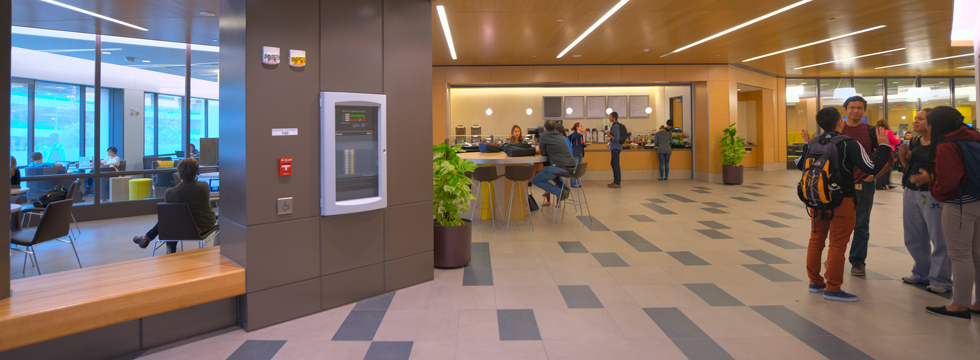
The University of Cincinnati reached a milestone this summer with the opening of the splendid Donald C. Harrison Health Sciences Library. This library is situated in the midst of a soaring, light-filled space that joins the new Center for Academic and Research Excellence (CARE)/Crawley Building with the existing Medical Sciences Building on UC’s Academic Health Center campus. Teaching, learning, and research will flourish in this impressive complex of research labs, teaching labs, health sciences library, faculty offices, classrooms, and student support areas.
The library is named for Donald C. Harrison, M.D., Senior Vice President and Provost for Health Affairs from 1986-2002, whose vision and generosity brought this project to fruition. When the UC Board of Trustees named the library for Dr. Harrison in March 2008, he said, “The library is a critical component of the education, research, and clinical care mission of the Academic Health Center. It provides a service that is absolutely essential. It lies in the heart of our new building and, in many ways, acts like the lifeline for UC’s up-and-coming physicians, scientists and health professionals.”
The new state-of-the art health sciences library serves the research needs of the students, faculty, and staff of the College of Medicine, the College of Nursing, the College of Allied Health Sciences, the James L. Winkle College of Pharmacy, and the Greater Cincinnati community at large. It also serves affiliated institutions, including University Hospital and Cincinnati Children’s Hospital Medical Center, as well as national and international scholars and researchers.
The health sciences library encompasses 44,872 square feet with a 90-seat computer lab, has over 200,000 print volumes on site, and provides access to over 600 online databases, 60,000 electronic journals, and 392,000 e-books.