Matheson-Cooper Report: The First Roadmap to the
Clinical Translational Science Awards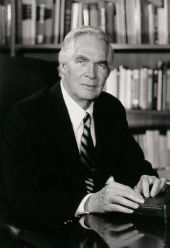 Donald A.B. Lindberg, M.D. Donald A.B. Lindberg, M.D.
Director, National Library of Medicine
National Institutes of Health
Matheson-Cooper Report: An Indelible Effect When the National Library of Medicine awarded a contract to the Association of American Medical Colleges to carry out the study that resulted in publication of the Matheson-Cooper report in 1982, the Library was dreaming of a future in which computers and telecommunications would revolutionize management of information in our academic medical centers. At the time most centers used information technology (IT) for administrative purposes, but in the domains of clinical care, education, and research, paper and telephones ruled except for scattered stand-alone IT applications installed by early adopters. I was a faculty member at the University of Missouri-Columbia and a member of the AAMC committee studying this matter. Both John Cooper and Nina Matheson proved to be fun to work with. Nina was “familiar with the potential of computing” having worked at the NLM previously. John was quite ready to see some major improvements in the information handling at the academic centers with which he was all too familiar. If I made any significant contribution to the group’s thinking, it was in bringing an enthusiasm for networks! The report proved to be innovative, provocative, and fruitful when it was published in October 1982. By then, I had come to NLM as Director and was obliged to find a way to finance the project we were all so enthusiastic about. NLM responded in 1984 by creating the Integrated Academic Information Management Systems (IAIMS) grant program to help academic health science centers plan for, model, and implement institutional approaches of the kind described by Matheson and Cooper. Over the next 23 years, IAIMS underwent some changes, broadened its scope beyond academic medical centers, and gained some variant branches but the central dogma, enunciated by Matheson and Cooper, never changed: optimal information management requires on-going planning on an institutional level. Much has changed in healthcare delivery, academic medicine, and IT since 1982, but the principles and imperatives of the Matheson-Cooper report remain valid. Holistic information management systems capable of evolving smoothly as times change remain an exception, information standards are still a work in progress, and now we must wrestle with information integration problems larger than those within an organization, e.g. regional health information exchanges. In its essence, the report remains a guide for all of us who wish to utilize optimally the full potential of IT for transforming and improving healthcare.
|